25th Eastern Gravity Meeting
EGM 2026
Dates: May 28-29, 2026
Location: Schwartz Auditorium, Rockefeller Hall, Cornell University, Ithaca, NY
The Eastern Gravity Meeting is an annual regional conference for researchers at all career stages working in gravitational physics. The meeting covers classical, quantum, theoretical, observational, and computational approaches to the study of gravity. It is open to participants from the Northeastern region and beyond.
Registration and Abstract Submission
Registration is free but required. Abstracts may be submitted using the form below.
Abstract submission deadline: May 8, 2026 (5:00 PM EDT)
Register and submit an abstract
We anticipate that each presenter will have 15 minutes total (12 minutes for the talk plus 3 minutes for questions). There will be a DGRAV prize for the best student talk.
Schedule
As of May 13, below is the tentative schedule. There may be minor adjustments to accommodate requests.
Day 1 Morning — Thursday, May 28
8:30 – 9:40 — Breakfast, coffee, and registration
9:40-9:45 - Welcome
Session Chair: Mike Boyle
9:45 – 10:00 — Qinyuan Zheng* — Testing General Relativity with Individual Supermassive Black Hole Binaries
Abstract
We develop a phenomenological framework for testing gravity beyond General Relativity (GR) with continuous gravitational waves from individual supermassive black hole binaries (SMBHBs). These long-lived low-frequency signals offer unique strengths for precision tests of gravity, since their coherent phase structure and cross-correlated signatures across multiple receivers, as in pulsar timing arrays (PTAs), retain detailed information about departures from GR. We consider three representative classes of deviations from GR: additional polarization states, modified dispersion relations, and parity-violating birefringence. We derive the associated observables, including cross-receiver correlation patterns and propagation-induced phase delays, and carry out injection-and-recovery simulations for breathing-mode and massive-gravity signals in PTAs. We find that the low frequency observations are particularly powerful for searches of alternative polarizations and modified dispersion relations, but much less sensitive to birefringence compared to high frequency detectors. For injections with beyond-GR parameters set by the current observational constraints, we demonstrate that the cross-correlated beyond-GR continuous-wave model derived in this work can recover the injected beyond-GR continuous-wave signals and distinguish them from a beyond-GR gravitational-wave background. More precise timing improves the recovery Bayes factors and puts more stringent constraints on the beyond-GR parameters. Our results support individual SMBHBs as a flexible and sensitive avenue for tests of gravity in the low-frequency gravitational-wave regime.10:00 – 10:15 — Bjorn Larsen* — Cross-correlation Signatures of Supermassive Black Hole Binaries in Pulsar Timing Arrays
Abstract
Pulsar timing arrays (PTAs) have established solid evidence of a nanohertz gravitational wave background, and the next frontier in the field is the search for continuous gravitational waves (CGWs) from individual supermassive black hole binaries. Previous CGW searches have primarily used deterministic templates, which are physically accurate but susceptible to bias from mismodeled noise artifacts in PTA datasets. Meanwhile, GW background searches are robust to noise mis-modeling by using the Hellings-Downs curve as the key observable for detection. We demonstrate how the same formalism can be applied for CGW searches, enabling robust hypothesis testing that relies solely on the cross-correlated component of a CGW. In addition, we discuss how this formalism is extended to enable tests of general relativity, frequentist "optimal statistic" analyses, and tests of GW coherence in the pulsar term.10:15 – 10:30 — Rachel Mechum* — Not All Mergers Are Equal: Waveform Systematics in Asymmetric BH Binaries
Abstract
As advanced LIGO's sensitivity improves, gravitational wave (GW) observations of binary black hole (BBH) mergers are revealing populations with increasingly unequal component masses. These unequal-mass systems, with mass ratios between 0.05 and 0.5, pose a particular challenge for waveform modeling. Current waveform models rely on approximations that can introduce systematic errors in this regime and bias inferred source properties like component masses and spins. Using the Rapid Iterative FiTting (RIFT) parameter estimation algorithm, we compare how different waveform approximants perform across this mass ratio regime and assess their impact on parameter recovery. This study provides essential groundwork for interpreting current GW catalogs and for the demands that next-generation detectors like the Einstein Telescope and Cosmic Explorer will place on modeling accuracy.10:30 – 10:45 — Natalie Malagon* — Assessing the imprint of eccentricity in GW signatures using two independent waveform models
Abstract
The gravitational wave signal from merging compact binaries encodes information about their orbital and intrinsic properties. Over the last few years, state-of-the-art waveform models have begun to incorporate the effects of orbital eccentricity into their estimated signal. Over a similar period, many groups have applied these waveforms to characterize whether the imprint of eccentricity is present and, if so, measure this time-evolving property (at a suitably-defined reference point). In this work, we present a comprehensive analysis of 162 confident sources identified in the O3 and O4a observing runs of the International Gravitational Wave Network (LIGO-Virgo-KAGRA). Using the RIFT parameter inference engine, we employ two independently implemented waveform models (SEOBNRv5EHM and TEOBResumS-Dali) which account for orbital eccentricity and the effects of aligned compact object spins. Using these two waveforms, we find consistent conclusions that disfavor the eccentric hypothesis. Unlike previous work, among binary black hole candidates, we find potential evidence for eccentricity in three events: GW200129, GW231001, and GW231123. For the latter two events, the evidence for eccentricity is ambiguous, with different degrees of support from different waveforms. Consistent with previous work, we find conclusions obtained about GW200129 can be sensitive to analysis settings, as expected, given the nonstationary noise present.10:45 – 11:00 — Bathroom break
11:00 – 11:15 — Jediah Tau* — Investigating Hardware Injections in LIGO O3 Data: Simulated Signals from a Neutron Star in a Low-Mass X-ray Binary
Abstract
During LIGO-Virgo-KAGRA's third observing run (O3), simulated continuous gravitational wave (CW) signals were added to the LIGO detectors as hardware (HW) injections, which are physical injections into the interferometer control loop via auxiliary laser actuation on test-mass mirrors. These included two periodic signals mimicking a spinning neutron star in a binary system, similar to the low-mass X-ray binary Scorpius X-1 (Sco X-1). HW injections serve as an important validation of a search method, as they occur before data cleaning and preparation. We searched for these injections using the model-based cross-correlation pipeline, which was used to search for CWs from Sco X-1 in the first three LVK observing runs. To simulate a realistic search, we used a search region of orbital parameter space of similar size to the plausible parameter ranges for Sco X-1, but containing the parameters of each HW injection. Our self-blinded analysis confidently detected one of the injections. The other, which was generated with a lower amplitude and in a more expensive region of frequency space, was not detected. We verified the imprint of this second signal by performing a deeper targeted search at its true parameters. However, such a deep search across the full parameter range would have been computationally infeasible.11:15 – 11:30 — Vikas Jadhav Y* — Higher Mode Phase Marginalization
Abstract
Fast and efficient Bayesian analysis is critical for Gravitational-wave parameter estimation. One key approach is marginalizing the likelihood over extrinsic parameters, such as the overall phase of the signal. Current phase marginalized likelihood models are restricted to signals containing only a single mode, requiring sampling over the phase in the presence of higher modes, decreasing the efficiency of parameter estimation. Signals from sources such as Extreme Mass Ratio Inspirals, and nearly edge-on binaries , are expected to contain an appreciable amount of power in the higher modes, potentially leading to expensive parameter estimation. To address this, we provide a robust, accurate, analytic phase marginalized likelihood model that is applicable even in the presence of arbitrary numbers of modes. This is done by using the saddle point approximation of the integral of likelihood over the phase, with added corrections. We also discuss the possibility of using the closed form solution to potentially marginalize over other extrinsic parameters such as distance, polarization, or inclination.11:30 – 11:45 — Vaishak Prasad — Accelerated time domain analysis for gravitational wave astronomy
Abstract
In this talk, I describe how structured linear algebra, and GPU computing can be used to accelerate time domain analysis of gravitational wave signals to feasible computational times.11:45 – 12:00 — Varenya Upadhyaya* — Parameter estimation with numerical relativity surrogate models
Abstract
Ground-based gravitational wave detectors have now observed a large number of binary black hole and binary neutron star mergers, with parameter estimation serving as the primary tool for inferring the physical properties of these systems. Extracting this information reliably relies on accurate waveform models, as systematic errors in the templates used for parameter estimation can directly bias inferred source parameters. Numerical relativity surrogate models are time-domain waveform models built directly from numerical relativity simulations, and their high accuracy makes them particularly suitable for parameter estimation, especially in regimes where such systematics are a concern. However, existing pipelines for surrogate-based parameter estimation support only a limited number of models, and here we present a new interface designed to work out of the box with the full suite of models available in the public repository `gwsurrogate`. We demonstrate this interface through parameter estimation runs performed with `bilby` and present results from a selection of these analyses.12:00 – 1:30 - Lunch break
Please see below for a list of restaurants.
Day 1 Afternoon — Thursday, May 28
Session Chair: Keefe Mitman
1:30 – 1:45 — Adhrit Ravichandran* — Numerical relativity surrogate models for waveforms and remnant quantities from non-spinning eccentric binary black hole coalescences
Abstract
Over the past decade, gravitational-wave detections from LIGO–Virgo–KAGRA have opened up a new avenue to study black hole astrophysics, offering unprecedented insights into the formation, dynamics, and final states of merging compact objects. For these analyses, models for waveforms and remnant quantities from binary black hole (BBH) coalescences are instrumental. Numerical relativity (NR) accurately evolves BBH systems to generate accurate GW and remnants, but its high computational cost limits direct use for data analysis. Surrogate modeling offers a fast and accurate data-driven method to replicate waveforms and remnant quantities comparable in accuracy to the underlying NR data. We present a 3-dimensional model for waveforms (NRSurE\_q4NoSpin) and merger remnants (NRSurE\_q4NoSpin\_Remnant) from eccentric BBHs with mass ratios up to 4 and eccentricity less than 0.33 as measured at a reference time of 3000M before peak invariant amplitude.1:45 – 2:00 — Abhishek Ravishankar* — Improved numerical relativity surrogates using domain decomposition
Abstract
Gravitational inspiral-merger-ringdown (IMR) waveform modeling of binary black hole systems (BBHs) is key to our ability to detect gravitational waves and to extract physics from these detections. Numerical relativity surrogate models are powerful IMR waveform models that leverage the accuracy of numerical relativity while extending parameter space coverage. Robust, accurate surrogate models, such as NRSur7dq4, cover a subspace of the precessing quasi-circular parameter space. However, there is evidence to suggest that, while NRSur7dq4 is accurate over the time domain as a whole, it may be possible to further increase accuracy in the ringdown, which is important for performing various tests of GR and consistency checks on the properties of the remnant black hole. We present a domain-decomposed methodology for surrogate construction that allows for more targeted modeling choices on the individual subdomains while preserving waveform smoothness. We employ this methodology to construct NRSur7dq4v2, an inspiral-ringdown domain-decomposed surrogate that improves upon NRSur7dq4 in ringdown accuracy. Specifically, NRSur7dq4v2 is three times as accurate as its predecessor in extracting remnant black hole parameters from its ringdown signal. We conclude by discussing the performance of NRSur7dq4v2 under other such tests, as well as the applications of our improved waveform model to problems such as parameter estimation of mergers of heavy binary black holes.2:00 – 2:15 — Michael Boyle — A Neural Bridge from Post-Newtonian to Numerical Relativity
Abstract
Post-Newtonian (PN) theory elegantly describes binary inspiral but breaks down near merger, while numerical relativity (NR) is accurate but expensive and sparsely sampled in parameter space. We present a physics-informed neural network (PINN) framework that learns to correct PN orbital dynamics and waveform modes to match NR. Physically motivated loss terms enforce symmetries such as the Newtonian limit and mode suppression at equal mass, enabling reliable extrapolation beyond the training set. The result is a PN-to-NR bridge that substantially improves waveforms through late inspiral, pointing toward models that generalize more robustly across parameter space.2:15 – 2:30 — Estuti Shukla* — Identifying Spacetime using Neural Networks
Abstract
In general relativity, determining whether two spacetime metric solutions expressed in different gauge describe the same physical scenario poses a significant challenge. This study proposes a novel approach to addressing this problem within the context of numerical relativity by leveraging neural networks. Specifically, we introduce the first implementation of neural networks trained to learn the coordinate mapping between two metric solutions that share identical manifold structure.2:30 – 2:45 — Matthew Stearns* — Visualizing Binary Black Hole Mergers in Eccentric Orbits
Abstract
We extend the open-source Binary Black Hole Explorer (binaryBHexp) package, enabling on-the-fly interactive visualization of eccentric BBH systems using numerical relativity (NR) data from the Simulating eXtreme Spacetimes (SXS) collaboration. From a range of configurations, the data-guided animations demonstrate the orbital motion, gravitational-wave emission, and evolution of the final BH remnant’s spin and recoil. The inclusion of eccentricity allows the visualization of expected gravitational bursts and spin-orbit coupling effects that are absent in circular models, providing researchers and educators with an intuitive view of relativistic dynamics. Some of the LIGO/Virgo/KAGRA detections have already shown possible hints of eccentricity, and these visualizations can be used to interpret and build intuition for eccentric binaries. Furthermore, as LISA gets closer to launch date, such visualizations will be essential for interpreting extreme mass ratio inspirals, which are expected to retain substantial eccentricity.2:45 – 3:00 — Som Dev Bishoyi* — Exact Radiation Boundary Conditions and Near-to-Far Field Teleportation for the Time-Domain Teukolsky Equation
Abstract
A wide range of theoretical and astrophysical problems—including modeling gravitational waves from extreme mass ratio inspirals (EMRIs)—require the accurate numerical solution of the time-domain Teukolsky equation for spin weight s=−2 in Boyer–Lindquist coordinates. However, long-time evolution of this equation is notoriously hampered by unphysical reflections from the outer boundary and by slowly growing spurious modes that contaminate the physical waveform. We develop and implement exact radiation outer boundary conditions (ROBCs) for the Bardeen–Press equation (the a=0 limit of the Teukolsky equation), which make the outer boundary fully transparent without the need for coordinate compactification or auxiliary transformations. In addition, we construct near-field-to-far-field teleportation kernels that allow the waveform to be evaluated directly at future null infinity from data recorded at a finite radius. Our results demonstrate that these boundary treatments eliminate unphysical late-time growth, yield the correct asymptotic decay rates, and enable efficient, long-duration time-domain simulations relevant to EMRI waveform modeling and other black hole perturbation problems.3:00 – 3:15 — Carlos Lousto — Next Generation Numerical Simulations for Next Generation Gravitational Waves Detectors
Abstract
We study the current binary parameter coverage, waveform length, and accuracy, and its projection towards next generation gravitational wave detectors requirements with specific sets of simulations at different numerical resolutions and convergence rates.3:15 – 3:45 — Coffee break
Session Chair: Eanna Flanagan
3:45 – 4:00 — Henry Huang* — Preliminary results for 3D puncture evolution with spectral methods
Abstract
Successful modern numerical relativity code simulates binary black-hole mergers using either the puncture formulations (BSSN, CCZ4, Z4c, etc.) or the generalized harmonic (GH) formulation. The puncture formulations are usually evolved in their second-order forms with finite differencing, while the GH formulation is evolved in a first-order reduction form with high-order spectral methods, such as the discontinuous Galerkin method. As a result, the GH formulation can achieve much higher accuracy and efficiency than the puncture formulations with the same computing resources. Despite considerable effort, the puncture formulations remain largely incompatible with spectral methods, as it proves difficult to find a first-order reduction with the desired hyperbolicity and constraint damping, while most spectral methods do not naturally apply to second-order hyperbolic forms. In this talk, we demonstrate that the local discontinuous Galerkin method may be applied to the second-order puncture formulations directly to simulate 3D black-hole spacetime, without the need for a suitable first-order reduction. Together with a small low-order spectral element or finite difference mesh keeping track of each puncture, we expect to be able to simulate binary black-hole mergers in the puncture formulations with improved accuracy and efficiency.4:00 – 4:15 — Michael Murphy* — Computational Dimension Reduction by Symmetries and the Cartoon Method
Abstract
Evolving a spacetime with a continuous symmetry, such as spherical or axisymmetric, does not require a full 3+1 evolution. Rather, symmetries allow a subspace of codimension equal to the number of Killing vectors to be evolved, with fields and their derivatives being extended into the bulk by Lie dragging. We overview the Cartoon method, which is the prescription to do this computational dimension reduction, and discuss the different features required in SpECTRE for both Discontinuous Galerkin and Finite Difference evolution.4:15 – 4:30 — Juan Guillermo Trejos Forero* — Conformastationary Axially Symmetric Solutions of the Einstein–Maxwell Equations with Magnetically Polarized Matter
Abstract
Exact solutions to the Einstein–Maxwell equations describing axially symmetric, magnetized astronomical objects with anisotropic matter content are presented. The spacetime is modeled by a conformastationary metric, with all metric and electromagnetic potentials depending on cylindrical coordinates, while the source is described by an anisotropic fluid with three distinct principal pressures. Magnetization is incorporated through a linear constitutive relation between the polarization tensor and the electromagnetic field tensor. The system is solved by combining the Einstein and Maxwell equations with new boundary conditions defined on a closed surface representing the object, from which explicit analytical expressions for the state variables are obtained. Two solutions are found: one regular and one singular at the center. Both configurations satisfy the energy conditions only partially, as regions with negative energy density arise within the domain, while still admitting well-defined equilibrium configurations determined by the imposed boundary conditions.4:30 – 4:45 — Nicholas Corso* — A comparison of gravitational wave computation methods in core collapse supernovae with hadron-quark phase transitions
Abstract
The occurrence of hadron-quark phase transitions in proto-compact stars during core-collapse supernovae (CCSNe) may produce unique kHz gravitational wave signals that can constrain the properties of quark matter. Robust simulations to date have only modeled this phenomenon using static spacetime geometry or limited implementations of general relativity, so their gravitational waveforms are confined to the standard quadrupole formula approximation. However, it is unclear whether this approximation is valid in such a tightly bound system. In this study, we consider the phase transition in CCSNe using the open-source numerical relativity code SpECTRE, which evolves the system with a dynamical spacetime. With this capability, we investigate the validity of the quadrupole approximation compared against the more exact Cauchy characteristic extraction of waveforms, and we measure the curvature of the system.4:45 – 5:00 — Samantha Rath* — Neutrino-Matter Interactions in Neutron Star Mergers: Effect of Inelastic Scattering on Neutrino Thermalization
Abstract
Neutron star-neutron star and neutron star-black hole binaries are the most promising systems for the joint detection of gravitational waves and electromagnetic signals. Our ability to analyze the observational data obtained from these systems heavily relies on numerical simulations that incorporate varied physical processes including general relativity, neutrino radiation transport and magnetohydrodynamics. The evolution of the neutrino transport equations still requires significant approximations in current simulations. This is potentially problematic when analyzing kilonovae to get deeper insights into the nature of the matter ejected by mergers as well as when studying the contribution of ejecta to the nucleosynthesis of elements. One important source of uncertainty is the use of approximate neutrino-matter interaction rates. The current study analyzes relative reaction rates from standard charged current, elastic scattering reactions, pair processes and inelastic scattering on 3D snapshots of a SpEC merger simulation using the NuLIB library, in order to identify regions in which various reactions matter and guide the development of new numerical methods and improved neutrino-matter interaction rates.5:00 – 5:15 — Yi Qiu* — Binary neutron star merger with neutrino moment transport and neutrino flavor conversions
Abstract
I will show our numerical relativity simulations of binary neutron star mergers incorporating M1 neutrino transport and BGK subgrid flavor transformations. In both long-lived and short-lived remnant scenarios, neutrino flavor conversions modify species-dependent neutrino luminosities and mean energies, and drive the matter towards more neutron rich conditions, which significantly boost the r-process yields. Flavor conversions may also contribute to stronger gravitational wave and neutrino emissions, pointing to a correlation between neutrino transport and merger dynamics. Furthermore, I will present new results with the GRMHD+neutrino simulations performed by the GPU-portable code AthenaK.5:15 – 5:30 — Mudit Garg — Chaotic migration of LISA Extreme Mass Ratio Inspirals in a turbulent gas flow
Abstract
One of the primary sources for LISA is extreme-mass-ratio inspirals (EMRIs), which typically form in an accretion disk around the galactic central supermassive black hole (SMBH). Due to gas torques on the binary, EMRI's gravitational wave (GW) driven inspiral trajectory deviates from the vacuum expectation, leading to GW dephasing (\( \Delta \phi \)). This phenomenon has naturally attracted significant interest in the literature because EMRIs can spend up to ~10^5 GW orbits in the LISA band; hence, even a small deviation could accumulate over time to become LISA-observable. However, most studies have focused on computing \( \Delta \phi \) in a thin, laminar disk, where flow turbulence is negligible and the disk exerts a fairly well-understood linear torque. But the laminar assumption is unrealistic because we expect hot, magnetized plasma near the SMBH to exhibit turbulence driven by the magneto-rotational instability. I will present a simple yet effective model of turbulent torque by superimposing a stochastic torque on the linear torque, inspired by a recent global hydrodynamical study. Our results suggest that turbulence enhances \( \Delta \phi \) in an expected EMRI-disk parameter space by episodically increasing gas torque amplitude, providing even stronger probes of gas physics with LISA. Moreover, turbulence can also enhance the expected EMRI rate at the expense of stellar-BH mergers by preventing the formation of migration traps.Day 2 Morning — Friday, May 29
8:30 – 9:45 — Breakfast, coffee, and registration
Session Chair: Joseph Balsells
9:45 – 10:00 — Paulami Majumder* — Causal Time-Dependent Excitation of Quasi-Normal Modes in Kerr Extreme Mass-Ratio Inspirals
Abstract
Extreme mass-ratio inspirals (EMRIs) are primary targets for LISA and a central focus of self-force and black-hole perturbation theory. In standard modelling, quasi-normal modes (QNMs) are associated with the post-merger ringdown, while inspiral dynamics are described in terms of slowly evolving orbital harmonics. In this talk, I present a causal, time-dependent framework to investigate whether QNMs can be dynamically excited during the inspiral phase itself. The approach is based on the retarded Green’s function of the Teukolsky equation, allowing QNM excitation amplitudes to be computed directly from evolving EMRI trajectories in Kerr spacetime. This formulation provides a clean separation between orbital forcing and the intrinsic response of the spacetime, without assuming periodic motion. I will discuss three excitation channels: enhancement near the light ring, transient resonances from approximate frequency matching, and non-adiabatic excitation during separatrix crossing. The results establish conditions under which QNM contributions may accumulate and induce observable dephasing, with implications for EMRI waveform modelling and strong-field tests of gravity.10:00 – 10:15 — Devin Becker* — Eccentric Ringdown from Binary Black Hole Mergers in the Extreme Mass Ratio Regime
Abstract
Black hole binaries with extreme mass ratios will be critical targets for the forthcoming Laser Interferometer Space Antenna (LISA) mission. The extreme-mass-ratio limit also provides useful tools for studying the dynamics of compact binary systems and the gravitational waves they emit. Using an eccentric Ori-Thorne procedure, we build worldlines that describe the full inspiral and plunge of a small body on an initially eccentric orbit of a Kerr black hole. We then calculate the gravitational waves associated with these trajectories with a code that solves the Teukolsky equation in the time domain. The ringdown from such a waveform consists of a spectrum of Kerr quasinormal modes (QNMs), followed by a power-law tail. In this work, we examine the impact of orbital eccentricity and its associated phase parameter, the radial anomaly angle, on the excitation QNMs and power-law tails. For some anomaly angles, the relative excitations of QNMs are essentially indistinguishable from those excited in quasi-circular coalescences. Consistent with other recent studies, we find that eccentricity tends to amplify the late-time power-law tail, though the amount of this amplification varies significantly with orbital anomaly. We thus find that eccentricity can have a distinct impact on the late-time coalescence waveform, but the interplay of eccentricity and orbit anomaly complicates this impact.10:15 – 10:30 — David Wu* — Quasinormal modes of deformed black holes: parity and isospectrality breaking
Abstract
While most gravitational wave tests of General Relativity (GR) are designed to be theory-agnostic, theory-specific approaches can deliver more stringent and physically meaningful constraints. In the case of ringdown-based tests of GR, such theory-specific approaches require computing the quasinormal mode (QNM) spectrum in particular beyond-GR theories. In this talk, we discuss using the modified Teukolsky formalism to compute the QNM shifts of parametrically deformed black holes, focusing on the Johannsen-Psaltis metric. We find that the beyond-GR effects break the isospectrality between even and odd parity perturbations but do not mix definite-parity modes. Inspired by this example, we give a condition that a beyond-GR metric must satisfy to admit definite-parity QNMs. This work advances understanding of parity and isospectrality breaking in beyond-GR QNMs, offering a path to interpret potential ringdown deviations from GR.10:30 – 10:45 — Viviana Caceres* — Estimating the intrinsic dimension of ringdown frequencies and damping rates
Abstract
A perturbed Kerr black hole emits gravitational waves that can be expressed as an infinite sum of damped sinusoids known as quasinormal modes. According to the no-hair theorem of general relativity, the frequency and damping rate of each mode are uniquely determined by the black hole's mass and spin. Here, I apply statistical methods to estimate the intrinsic dimension of measured frequencies and damping rates from gravitational wave observations. I examine the performance of intrinsic dimension estimators in recovering a dimension of 2 from higher-dimensional measurements of quasinormal mode frequencies and damping rates, with and without noise. Finally, I discuss how these methods could be applied to future observations as a novel test of the no-hair theorem and a means of constraining non-Kerr degrees of freedom predicted by alternative theories of gravity.10:45 – 11:00 — Bathroom break
11:00 – 11:15 — Alex Correia* — Varying sky location and coalescence time in black hole spectroscopy
Abstract
The direct detection of gravitational waves (GWs) has unlocked the ability to perform high-precision tests of general relativity at the horizon-scale level. For example, we can test the no-hair theorem by decomposing the post-merger “ringdown” into a series of quasinormal modes (QNMs). The detection of QNMs in GW signals is a subject of contention in the literature, spurred primarily by disagreements on where the ringdown start time is fixed. Here, we present a method of marginalizing over sky location and coalescence time uncertainties when performing parameter estimation for ringdown analyses. Our methods overcome traditional challenges with varying GW arrival times by utilizing a “gating and in-painting” approach to excise pre-merger data. We validate our method with simulated GWs, and apply it to significant observations, such as GW150914 and GW250114, to determine the evidence for multiple observable QNMs.11:15 – 11:30 — Kanchan Soni — Physically motivated hierarchical search for gravitational waves
Abstract
Matched-filter searches for gravitational waves from compact binary mergers are becoming increasingly expensive as waveform models incorporate additional physical effects such as orbital eccentricity, tidal deformability, higher-order modes, and spin precession. We present a physically motivated hierarchical search framework that exploits the frequency-ordered accumulation of signal-to-noise ratio (SNR) to reduce computational cost while preserving detection sensitivity. Focusing on eccentric neutron star-black hole binaries, we develop a two-stage frequency-based hierarchy in which a computationally inexpensive coarse search above a raised low-frequency cutoff identifies candidate events that are subsequently followed up with localized full-band matched filtering. Using injection-recovery studies in simulated O4-like Gaussian noise, we show that mildly eccentric signals retain 70-80% of their full-band SNR for cutoffs of ~60-80 Hz, while the associated eccentric template-bank size decreases by orders of magnitude. We further demonstrate that the overall efficiency of the hierarchy depends critically on the implementation of the follow-up stage, with localized Finite Impulse Response and reduced-basis methods yielding substantial reductions in refinement cost relative to standard Fast Fourier Transform -based filtering. These results establish physically motivated hierarchical filtering as a promising strategy for scalable searches in current and next-generation gravitational-wave detectors.11:30 – 11:45 — Keefe Mitman — Constraining Gravitational Wave Memory with Hierarchical Inference
Abstract
With the multitude of gravitational wave observations that have been made in the past ten years, probing the dynamical and nonlinear nature of strong gravity is becoming more and more feasible. One promising way to test the nonlinear nature of Einstein's theory of general relativity (GR) is through the gravitational wave null memory effect: a nonlinear prediction of GR which corresponds to initially co-moving observers being permanently displaced due to a burst of gravitational radiation. Previous studies have shown that, while it is unlikely that the memory effect will be observed in a single event by the LIGO-Virgo-KAGRA (LVK) detectors, evidence for memory in the population of LVK events should be attainable after \( \sim \)2,000 gravitational wave detections. These works, however, relied on Bayes factors to perform their population analyses: an a approach that can depend sensitively on the analysis priors and, when naively multiplied across many events, can even favor incorrect conclusions. In this work, using the GWTC-4.0 catalog of binary black hole observations, we instead perform hierarchical Bayesian inference---which is not subject to the issues associated with Bayes factors---to measure the evidence for memory in current LVK observations. We find that we can constrain what we call the memory enhancement factor---the constant appearing in front of the contribution to the strain from the supermomentum flux---to 0.682 +/- 4.174, consistent with its expected value of 1. Also, in large agreement with prior works, we forecast that \( \sim \)2,000 detections will be needed to constrain the uncertainty in the memory enhancement factor to \( \lesssim 1 \).11:45 – 12:00 — Siddhant Siddhant* — Detection prospects of memory effects with Cosmic Explorer
Abstract
Memory effects in gravity are lasting changes in the spacetime metric following the passage of radiation. The most well-known example is the displacement memory effect, which appears as a non-oscillatory (DC) offset in the gravitational-wave strain. Recent work has identified a new “hierarchy of memory effects” arising from the flux-balance laws associated with Bondi aspects. The first few members of this hierarchy include the displacement, spin, and center-of-mass memory effects. In this talk, we will discuss the prospects for detecting these effects up to 3rd order in the hierarchy with Cosmic Explorer. Detecting higher memory effects from individual gravitational-wave events is challenging. We therefore follow a stacking approach in which sub-threshold evidence from many individual events is combined to build statistically significant evidence for memory effects in a population of black-hole mergers.12:00 – 1:30 - Lunch break
Please see below for a list of restaurants.
Day 2 Afternoon — Friday, May 29
Session Chair: Nils Deppe
1:30 – 1:45 — Aleyna Akyüz* — Early Warning and Dynamical Tuning For Cosmic Explorer
Abstract
Cosmic Explorer, a next-generation gravitational-wave observatory, is expected to achieve up to an order-of-magnitude improvement in sensitivity over current detectors, enabled by its significantly longer arms. Its design is guided by targeted science goals, but these introduce trade-offs across different frequency ranges. In this work, we explore multiple detector configurations to characterize these trade-offs and investigate a hypothetical scenario in which configurations can be switched dynamically in response to incoming gravitational-wave signals, evaluating whether the potential scientific gains justify the development of such a capability. We consider a range of switching strategies, varying both the timing and duration of the switch, and assess their impact on key science cases, including measurements of neutron star tidal deformability, detection of Population III black holes, and the detectability of post-merger signals.1:45 – 2:00 — Labani Roy* — Observation of Environmental Effects in Compact Binaries with Ground-based Observatories
Abstract
The presence of a third object (e.g., a supermassive black hole or a dense star cluster) in the vicinity of a binary can induce a time-dependent center-of-mass (CoM) velocity of the binary, whose line-of-sight component imprints a time-varying Doppler shift on the binary’s gravitational-wave (GW) signal. I investigate the time-dependence of this line-of-sight velocity (LOSV) from GWs to probe astrophysical environment of compact binaries. Unlike previous post-Newtonian phase corrections, I apply the time-varying Doppler transformation directly to existing base waveform models. Our waveform model is compatible with any base model and preserves all underlying physical assumptions. This approach further enables the incorporation of arbitrary velocity profiles to generate Doppler-shifted signals. We perform Bayesian inference using our Doppler-shifted model, analysing for the first time all currently available ground-based observations of LIGO sources. We find no evidence of time variation in the LOSV, consistent with the limited measurability of dephasing in short-duration signals.2:00 – 2:15 — Keisi Kacanja* — Search for Sub-Solar Mass Binaries in the First Part of LIGO’s Fourth Observing Run
Abstract
The observation of sub-solar mass (SSM) compact objects offer a unique window into physics beyond standard formation evolutions, providing potential evidence for primordial black holes or non-standard neutron star populations. We present the first results of a targeted SSM search using data from the first part of the Advanced LIGO’s fourth observing run (O4a). For the first time, we explicitly incorporate tidal effects for extremely low-mass neutron stars, covering tidal deformabilities up to 700,000. While no statistically significant candidates were identified, the increased sensitivity of O4a allows us to place the most stringent constraints on the local merger rate. We report a two-fold improvement over the combined sensitivities of the first three observing runs. Furthermore, we provide new constraints on the local PBH dark matter fraction, offering complimentary constraints to existing microlensing bounds.2:15 – 2:30 — Yixuan Dang* — Next-generation dark sirens for precision measurement of the Hubble Constant
Abstract
Gravitational waves (GW) from merging compact objects provide a new way to measure the expansion rate of the Universe through “standard sirens.” While the current best result relied on events with electromagnetic counterparts, most detections, especially binary black hole mergers, are “dark” and lack such signals. Even so, these dark sirens can be used for cosmology by statistically linking them to galaxies in large surveys (i.e. the galaxy-catalog method). In this talk, we show how golden and silver dark sirens can lead to meaningful measurements of the Hubble constant. Using data from the Hobby–Eberly Telescope Dark Energy Experiment, we demonstrate that dedicated spectroscopic follow-up surveys provide the necessary redshift information with high completeness and precision. With upcoming improvements in GW detectors, this approach could yield a measurement of the Hubble constant at the few-percent level within the next few years. Standard sirens thus offer a powerful and independent way to address the current tension in measurements of the expansion rate of the Universe.2:30 – 2:45 — Daniel Paraizo* — Minimum lifetime of a black hole
Abstract
Recently, an expression for the radiative Bondi flux of Hawking radiation in a spherically symmetric model was identified. This new flux expression is used to investigate the entanglement entropy of Hawking radiation at null infinity through an energy-entropy relation. We show this relation implies that i) there is large entanglement across the semiclassical 'last ray' when the black hole reaches a Planck mass; and ii) there is a lower bound on the purification time of the black hole that scales as M^4, where M is the initial black hole mass. Under the additional assumption that the remaining energy flux from the black hole is emitted as slowly as possible, this purification time is extended to be exponential in the initial black hole mass. Our results indicate that information is recovered slowly and does not occur while the black hole is still macroscopic. We comment on phenomenological implications for primordial black holes and remnants.2:45 – 3:15 — Coffee break
Session Chair: Nils Deppe
3:15 – 3:30 — Monica Rincon-Ramirez — A Maximum Entropy Puzzle for Black Hole Mergers
Abstract
While the evolution of a black hole binary coalescence is fully described by general relativity, the underlying equations are highly non-linear and require computationally demanding simulations for predicting the final state. By analogy with a classical gas, one may ask: can this system be understood from a simpler thermodynamic perspective? In this talk, I present to you a puzzling and suggestive result for non-spinning systems following quasi-circular orbits: When the binary's instantaneous mass and angular momentum are mapped to those of a hypothetical Kerr black hole, the corresponding entropy exhibits a maximum during the evolution. This maximum occurs strikingly close to the final remnant predicted by numerical relativity.3:30 – 3:45 — Rahul Solanki — On the frame-drag field in general relativity
Abstract
In the absence of gravity, the relative velocity between two inertial observers doesn't change. Moreover, if these observers are carrying inertial-guiding gyroscopes, their relative orientation doesn't change, or there is no relative precession between the two. In the presence of gravity, however, freely falling observers are only locally inertial. In other words, they only detect gravitational field via non-local effects: two infinitesimally separated inertial observers notice relative acceleration due to the tidal field and differential precession of gyroscopes due to the frame-drag field. For example, if these two observers are at rest and their gyroscopes are aligned with respect to each other at some instant, they will be moving, and their inertial-guiding gyroscopes will be misaligned at the next instant. Here, the tidal field has a Newtonian analog (e.g., ocean tides), but the frame-drag field does not. In this talk, I will define the frame-drag field in terms of inhomogeneity in the gravitational field at some instant rather than the rate of change of misalignment between two infinitesimally separated gyroscopes.3:45 – 4:00 — David Grant Taylor — Frequency Decay through Electromagnetic Radiation Absorption and Re-Emission by Inter-Galactic Dark Matter as an Alternate Explanation for the Hubble Constant
Abstract
There is an alternate cause for the decay rate defined by Edwin Hubble’s Cosmological Constant Theory. It can be proposed because inward motion is observed in the local Galaxies||Star groups around the Milky Way. The recession velocity of Galaxies farther out of is reasoned entirely from the increasing redshift in the frequency. The smaller the image of observed Galaxy/Cluster objects, the greater the downward shift in frequency of all Electro-Magnetic signals [EM]. An alternate cause for that downward shift could be through the absorption and re-emission through matter, leading to the absorption of some fraction of the energy quanta. There is nowhere in our Local Universe that is both absolutely devoid of matter and the continual formation of objects of all scales. If redshift was because of space expansion, it would increase the distance that signal had to travel. So a signal from GN-z11 stellar structure at 13.4 billion light years [LY] would take 13.4 billion years to travel. Assuming 13.8 billion years since the Big Bang would mean GN-z11 object travelled 13.4 billion LY in 400 million years. A current value for the Hubble constant is: H0=(67.8 ± 0.77) km s -1 Mpc -1 a frequency is shift of 67.8/c over a single Mpc. An alternate expression would be a shift factor 2.261560E-5 over a distance of 3.08567E22 m or a redshift of 7.32923E-28 over a metre because of passage through a medium. Dark matter is a currently accepted phenomenon. It is proposed that properties include redshift’s all normal matters that are put upon EM||Boson signals at the fraction stated above. The signal reduction|| frequency distortion happens at a quantum level for each occurrence, and so is not detectable until passage through millions of LY of Dark Matter. Support for this alternate supposition is reasoned from the fact that the M31 Galaxy and the NGC 300 Galaxy are at distances inconsistent with their Hubble recession velocity.4:00 – 4:15 — Best Student Talk Award
* Graduate student speaker
Travel
- Ithaca has a local airport https://www.flyithaca.com/ The airport has a red phone near the exit that allows you to contact a taxi.
- There are also airports within an hour drive in Syracuse, Elmira, and Binghamton.
- Many bus lines service Ithaca, including Grey Hound, FlixBus, and Cornell also runs a bus to/from NYC.
- It’s a beautiful drive to Ithaca!
Local transit
- Most hotels in Ithaca offer a free shuttle service to and from Cornell. Likely the easiest dropoff and pickup location should be Clark Hall.
- Ithaca also has an excellent bus system, Tompkins Consolidated Area Transit. You can use tap-to-pay to pay with a credit card directly. Fares are $1.50.
- There are very few to no ride share services like Lyft and Uber in Ithaca. You can easily wait an hour if you try to use those.
- Several taxi companies, like College Town Cab operate in Ithaca and are quite reliable.
- Cornell has some on-campus parking
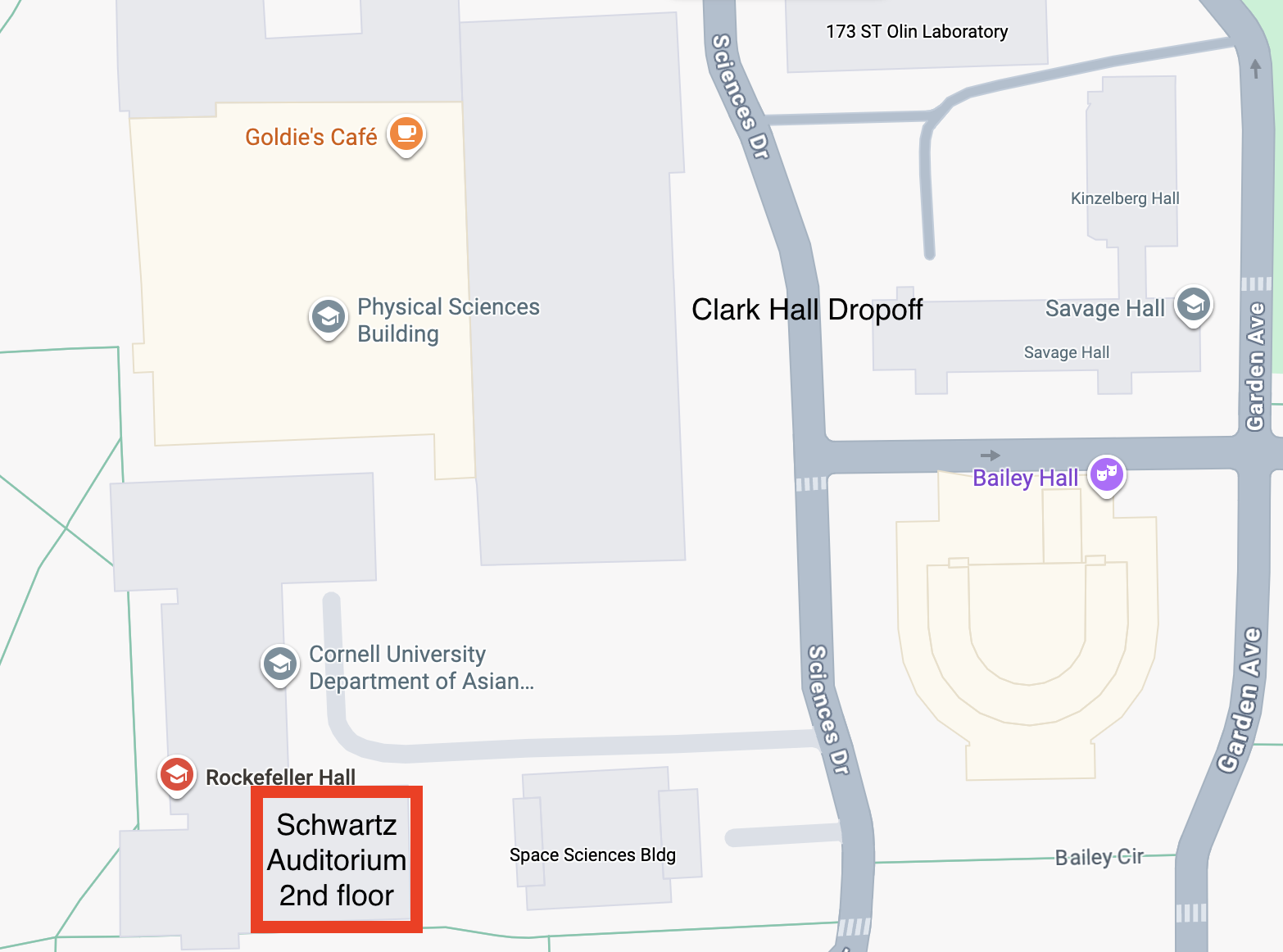
Shown is the location of Rockefeller Hall and where Schwartz Auditorium is. The Clark Hall shuttle dropoff location is also shown.
Accommodations
- The Statler Hotel is a very nice hotel run by the Cornell Hotel School.
- The Best Western is reasonably priced and runs a shuttle.
- The Dorm Hotel is about as close as possible, with a short walk up hill.
- Hotel Ithaca is conveniently located near the Ithaca Commons near many restaurants.
- Cayuga Blu Hotel is right on bust route 30, but is a bit more isolated. However, there are several good restaurants nearby.
Restaurants
Ithaca has a surprisingly large number of restaurants that offer very good food considering it’s a relatively small town. Some suggestions are:
Lunch:
- List from Cornell Dining
- Goldie’s in Physical Sciences Building
- Mann Cafe
- Martha’s Cafe
- Trillium Eatery
- Cornell Dairy Bar has amazing ice cream.
- Atrium Cafe
- College Town Bagels in College Town
- Fusia Bento Bar
- Pho Time Vietnamese
- Xi’an Street Food
- Gangnam Station
- Wings Over Ithaca
- In general, in Collegetown there are a lot of restaurants and its about a 10 minute walk.
Dinner:
- Ithaca Ale House
- Ithaca Beer Co.
- Simeon’s American Bistro
- Hawi Ethiopian Cuisine
- Bickering Twins Latin American
- Moosewood vegetarian
- Saigon Kitchen
- Maru Korea
- The Rook
- Sumo Japanese Sushi and Hibachi Grill
- Mitsuba Japanese
- Ciao! Woodfired Pizza and pasta
Sponsors
- Support through generous contributions from the Department of Physics.
Contact
For questions, please contact Nils Deppe.