Gravitational waves travel hundreds of millions to billions of light-years before reaching our detectors. Numerical simulations of merging black holes, however, cover only a finite region around them. To predict the signal far away, we hand data from the simulation to a second calculation that carries the radiation all the way to infinity.
But the simulation alone cannot get this calculation started: it needs the radiation everywhere from the edge of the simulation out to infinity, at the moment the simulation begins. How can we reconstruct data that the simulation cannot provide? Our new Letter and companion study, led by Guido Da Re, address this longstanding obstacle to producing accurate gravitational waveforms at infinity.
This second calculation is called Cauchy-characteristic evolution (CCE). It solves Einstein’s equations along surfaces traced out by outgoing light rays, using coordinates that bring infinity onto a finite computational grid. CCE is the more complete method: the simpler alternative, extrapolating waveforms measured at several distances, does not correctly recover every part of the signal. It struggles, for example, with gravitational-wave memory, a permanent change in the separation of freely falling objects after a wave passes.
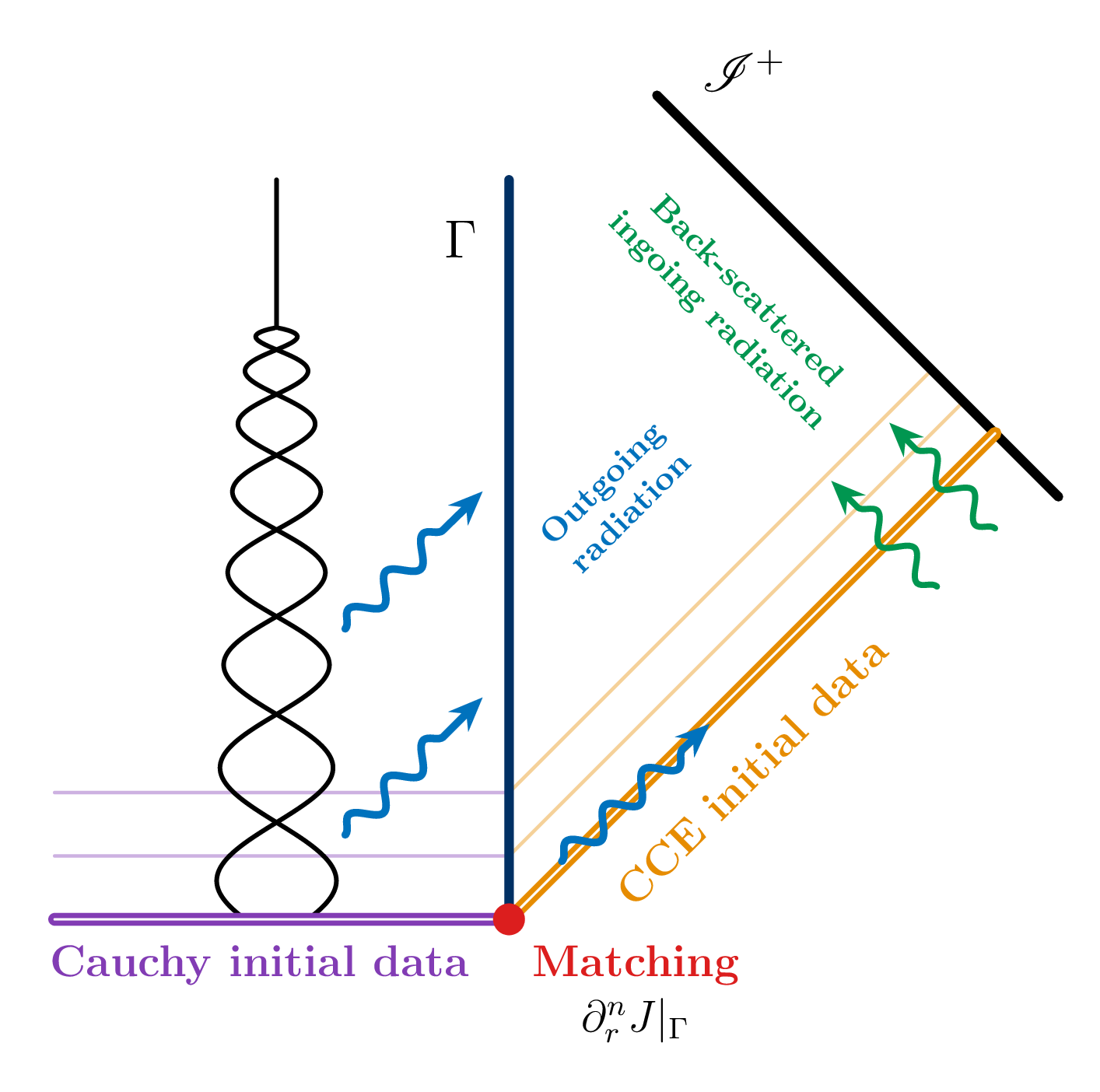
The initial radiation field that CCE needs includes both outgoing waves and radiation scattered back inward by spacetime curvature. This scattered radiation carries information about the system’s past. The key insight is that the initial radiation field and the coordinates used to describe it must be chosen together. Earlier approaches prescribed the coordinates separately, introducing unintended radiation into the initial data.
By providing inconsistent initial data, these approaches could even create gravitational waves around a single stationary black hole that should not radiate at all. In binary simulations, the artificial radiation contaminates the signal for several wave cycles. Our method instead derives the coordinates from the radiation field itself, which we reconstruct from the original simulation’s data while retaining the contribution from waves scattered back inward.
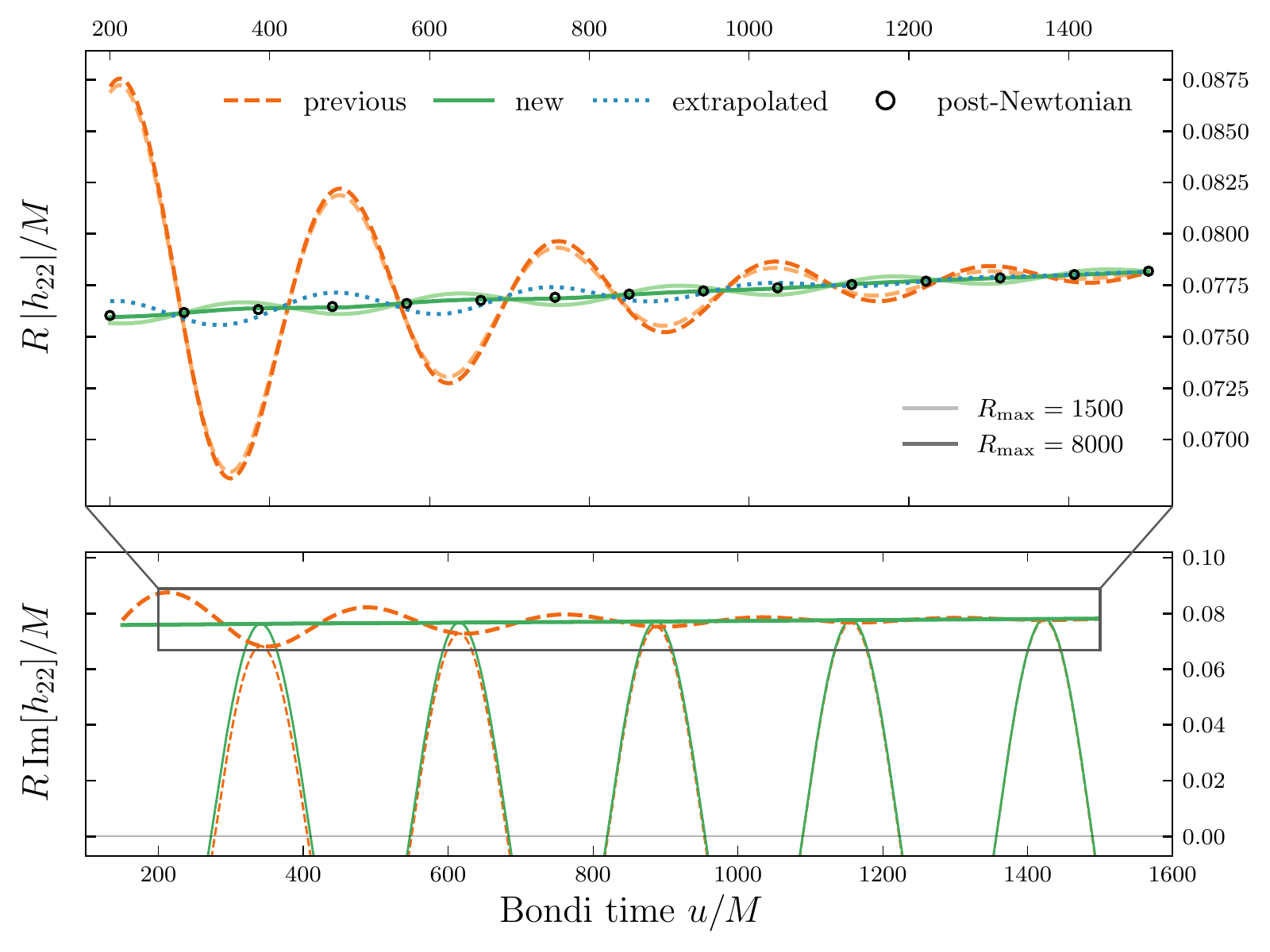
We implemented the method in SpECTRE and tested it on black-hole simulations produced with the Spectral Einstein Code (SpEC). Figure 2 shows an equal-mass, nonspinning binary. With the previous initialization, the amplitude of the waveform’s dominant component oscillates artificially by about 10% for several wave cycles. With the new initial data, this oscillation disappears, and from the very first cycle the waveform follows the post-Newtonian prediction, an analytic approximation valid while the black holes are far apart. The small oscillations that remain come from the original simulation’s outer boundary.
The improvement also extends to faint signals long after merger. After a head-on black-hole collision, for example, the radiation does not stop when the final black hole settles down: a weak tail remains, decaying slowly as a power law. With the previous initialization, this tail was buried under artificial radiation. The new initial data recover the expected decay, as shown in Figure 8 of the companion study.
These improvements can be applied to existing simulations with suitable stored boundary data, without repeating their expensive spacetime evolutions. The method does not depend on the particular approach used to solve Einstein’s equations in the original simulation, opening a path to recovering accurate CCE waveforms from the present simulations archives.
This work lays the foundation for improved waveform catalogs based on CCE. These catalogs will support more accurate models for interpreting gravitational-wave observations and for using them to study black-hole populations, test general relativity, and measure cosmic expansion.